
What Are Vapour Barriers and Do You Need One in Your Campervan? (2026)

Updated: Apr 8
Moisture is one of the quiet killers of campervan builds. We cook, sleep, and dry wet kit in a tiny metal box, then wonder why windows drip, insulation and wood gather mold, and rust creeps in behind the cladding. For housebuilders, the answer is often simple: fit a vapour barrier. In vans, it’s not so clear-cut. The steel shell is already a vapour barrier, the interior is full of awkward cavities, and a poorly detailed membrane can trap more moisture than it prevents. In this article, we’ll dig into what are vapour barriers, why vans are such a special case, and how far good ventilation can go on its own. Then, we’ll help you decide whether you need a vapour barrier at all, and if you do, how to implement a smart vapour control layer, with practical guidance on materials, layout, and installation.

Shane is an NCC-certified electrical installer.
He has built, taught, and lived in campervans since 2019.
This post contains affiliate links. We may earn a commission at no extra cost to you. To understand our policies on content, affiliate commissions, and liability, please review our Terms of Use.

In this guide
What Are Vapour Barriers?
Vapour barriers are layers of material with very low permeance that prevent the movement of water vapour through your layers of insulation. Practically, a vapour barrier is usually a layer of plastic-based material that we use to stop moisture from penetrating into layers that are sensitive to mold and rust, like insulation wool, wood, and metal. They're standard in home construction, but the campervan vapour barrier is a more controversial topic. Source
When we ask 'what are vapour barriers?', we should note the difference between vapour barriers vs. vapour control layers vs. air barriers. Whilst a vapour barrier essentially blocks all water vapour, a vapour control layer is something like a 'smart' membrane that allows some passage of vapour depending on temperature. This can be useful in certain contexts that we'll discuss later. You might also encounter the term 'air barrier', which is a separate concept and refers to a barrier against movement of air. Air is the main transport for moisture, so vapour barriers are often also air barriers, but they're not automatically the same thing.

Why is Vapour a Problem and Why is a Vapour Barrier Necessary?
The campervan vapour barrier is such a subject of discussion because of the serious effect vapour can have on the inside of your van. Campervans are inherently damp environments unless built thoughtfully. There are many campervan-specific sources of moisture in the form of water vapour:
People: the human occupants of a campervan put a lot of water vapour into the environment. The stats vary, but some sources indicate that a person produces 400ml of water a day in the form of breathed-out water vapour and evaporating sweat. Source
Cooking: most van builders don't install extractor fans over their stoves. This means that all that steam coming off your pots and pans stays in the air inside your van.
Propane appliances: if you use propane or LPG for your stove or if you have an LPG heating system, water vapour is produced as a byproduct.
Wet kit: Wet jackets, boots, ski gear, and surf gear transfer their moisture into the air as they dry.
Inside a van, all of this airborne moisture is concentrated in a far smaller space rather than being diffused throughout a house or a flat. The lovely people at FarOutRide demonstrated this by measuring the humidity and temperature in their van with sensors, and plotting the trends on a graph:

We can see that the humidity in their van fluctuated between a minimum of 22% and a maximum of about 55%, spending most of its time above 37%. If 100% humidity is when the air is maximally saturated with water, we can see that airborne moisture is a significant factor in campervans.
The Condensation Problem
The issue with airborne water vapour is that it tends to condense as liquid water on relatively cold surfaces.

You'll most immediately notice this in the form of condensation on your windows, but it also happens on your van's metal walls. Metal conducts cold from the outside into the van in a process called heat bridging. This is exacerbated by the fact that your van's walls are themselves uneven and constructed in a way that concentrates condensation:
Van walls are full of hollow regions like wiring conduits, support pillars, and struts
These hollow regions are impossible to insulate fully, meaning they're naturally colder than the rest of the van
Hollow regions are often penetrated by access holes on the inside and water drainage holes on the outside (as in the case of the hollow channels where the walls meet the floor), allowing moist air in from both inside the van and outdoors
Hollow, cold regions open to moist air are hotspots for condensation
This condensation then drives mold growth on wood and insulation wool, and causes rusting of metal.

The idea behind a campervan vapour barrier is that it's a layer of material that water vapour can't get through. When laid over the top of your insulation layers, an ideal vapour barrier would prevent vapour from getting through and condensing on heat bridges. This works fine in a stationary building, but campervans are unique environments where vapour barrier construction isn't as simple.
Why Vans are Unusual
What are vapour barriers in the context of campervans? As we explained in the previous section, the problem with vans is that the outer metal walls are already a zero-permeability layer which is prone to condensation. Whilst you might want to put in a vapour barrier to protect inner wall layers from moisture, any moisture that does get in is now sandwiched between two impermeable layers. This trapped moisture will dry very slowly and actually increase the risk of condensation and water damage. Herein lies the campervan vapour barrier controversy, and it's why some van builders advocate skipping the vapour barrier entirely.
The unique structure of vans further complicates things when we look at the practicalities of building a vapour barrier. Vans have curved panels, service cavities, dozens of penetrations for wires, and furniture mounts, sliding-door voids, and ongoing vibration. Achieving a truly continuous, genuinely airtight vapor barrier is very difficult, as even small defects allow moisture into the sandwich. Many van builders, like our friends at EXPLORIST.life, think that a true campervan vapour barrier is impossible to build. Source On the other hand, science-based van builder Greg Virgoe came to a different conclusion based on a series of tests detailed in his excellent video looking at campervan vapour barriers:
Greg's tests show that a vapour barrier does prevent condensation on a van's cold metal walls, but he cautions that this only works if it's installed near-perfectly. This means:
full sealing-in of all insulation behind the vapour barrier
full protection of all wood behind the vapour barrier
detailed application of vapour-blocking tape
no gaps or holes in the vapour barrier
Greg acknowledges the difficulty of achieving such a perfect vapour barrier, and his other videos demonstrate the viability of a no-vapour barrier build.
Ventilation: An Alternative to a Van Vapour Barrier
Many van converters simply aren't willing to deal with the complexity of implementing a perfect vapour barrier and the risks of trapped moisture if you get it wrong. Instead, they opt for a 'vapour-open' assembly. In this case, we accept that some moisture will inevitably come into contact with the wood and insulation in our walls and ceiling. To manage it, we focus on properly ventilating the van, keeping air moving and evacuating humidity through vents. In this way, we minimise humidity and allow our insulation to 'breathe', wicking away moisture and preventing it from hanging around long enough to cause any damage.

We've discussed the importance of a proper ventilation system before, in our articles on roof vents and air conditioning. In the UK and Europe, leisure vehicle standards require permanent safety ventilation anyway. BS EN 721:2019 requires campervans to have high-level and low-level permanent unpowered ventilation sized by the vehicle’s area. Practically, this translates to a certain area of roof-level venting plus a certain area of low-level venting.
EN 721 overall plan area (m²) | Minimum high-level area (roof vent) | Minimum low-level area | Typical van examples (overall plan area, approx) |
|---|---|---|---|
Up to 5 | 7,500 mm² | 1,000 mm² | Very small micro-campers; few panel vans are this small |
> 5 to 10 | 10,000 mm² | 1,500 mm² | Ford Transit Connect L1 (≈ 8.7m²) Connect L2 (≈ 9.5m²). |
> 10 to 15 | 12,500 mm² | 2,000 mm² | Ford Transit Custom L1 (≈ 10.3m²) Custom L2 (≈ 11.1m²) Transit L3 (≈ 12.3m²) Transit L4 (≈ 13.8m²) Fiat Ducato L2 (≈ 11.1m²) Ducato L4 (≈ 13m²) |
> 15 to 20 | 15,000 mm² | 3,000 mm² | Large coachbuilt/A-class motorhomes (panel vans rarely exceed 15 m²) |
These standards are focused on safety, but planning a van that passes them also goes a long way to solving the moisture problem. In addition to unpowered ventilation, we recommend the addition of powered ventilation in the form of a roof fan. Fans create reliable pressure-driven flow, pushing warmer, humid air out of the van and pulling fresh air in through the passive vents, all whilst maintaining a flow of air which encourages the evaporation of moisture. We installed a Dometic Fantastic Breathe 3100 in Shane's new van, exactly for this purpose.

We also installed a Dometic Heki Mini unpowered roof vent, to get the van up to the required 10,000mm² of permanent fixed ventilation area.
Windows contribute to ventilation too. Cracking a window during high-moisture activities like cooking provides a big ingress of fresh, less moist air whilst your fan is pulling the steamy air out. Fitting rain guards to your windows allows you to keep them open even when it's raining.

Put together, a well-thought out ventilation system gives you the classic pattern: exhaust warm, humid air at the roof while admitting cooler, drier air low down. The system allows you to effectively control both heat and moisture, which is why we also recommend it instead of air conditioning systems. With fixed ventilation sized to the standard and a decent fan creating a continuous path, most vans can keep airborne moisture in check without resorting to a campervan vapour barrier. However, there are situations where moisture and humidity might be more of a problem than a ventilation system can handle. We'll look at those in the next section.
Do You Need a Vapour Barrier?
We've established why moisture and condensation are issues in a campervan, and we've talked about the benefits and pitfalls of vapour barriers. We believe that in most cases, you don't need a campervan vapour barrier for the following reasons:
Vapour barriers only work to protect your wood and insulation if they're exceptionally well-installed
Any vapour barrier that allows water to infiltrate behind it will trap moisture in your insulation layers
A perfect vapour barrier is tricky and time-consuming to install in a van's uneven interior
A vapour barrier represents an additional cost in your conversion
Any van build should be properly ventilated anyway for safety and heat management reasons; this should also serve to manage moisture in most cases
This recommendation applies to the majority of vanlifers. However, in some use-cases, moisture is likely to become more of a problem than a well-ventilated build can handle.
Cold-climate, Heavy Winter Use
Snowy winter makes moisture management much harder. For one thing, you're more likely to have wet gear drying in the van if you're using it in a mountain or Nordic winter. Snowsports and outdoor activities in wet weather and wet terrain produce a lot of wet equipment, which you'll want to dry out inside your van. This significantly increases the moisture load in the inside air.
For another, cold temperatures increase the rate that moisture condenses on cold surfaces. Cold air holds less moisture, and everything takes much longer to dry out, including potentially damp insulation and wood in your walls.
Finally, when it's cold outside, you'll likely be keeping your ventilation closed to conserve warmth. You might not be able to crack a window to vent steam from cooking when it's -10°C outside, and you're unlikely to want to let warmth out of an open roof vent. You'll also be preparing more hot food and drinks, and spending more time inside your van overall.

For these reasons, we'd suggest that the moisture load inside your van during heavy winter use (long trips and full-time van life) is more than simple ventilation can handle. In this case, we'd recommend the installation of a vapour barrier.
Full-time Use in Wet Climates
If you're a full-time vanlifer in areas that get a lot of rainfall, we'd also suggest that over time, the moisture load will be more than ventilation can manage. Being in your van full-time creates a long-term, significant moisture load through cooking, breathing, and drying gear. In warmer, drier climates, this load is still counteracted by ventilation. However, in areas with long, dark winters, high rainfall, and long periods of cold weather, moisture is likely to be a long-term problem.
High atmospheric moisture content, like in the humid climates of the UK, Northern Europe, and the Northwestern US, discourages evaporation of moisture and limits the effect of ventilation. You're more likely to be tracking wet gear into your van, and again, you're unlikely to want all your ventilation open when it's chilly outside.

Thererfore, if you live full-time in your van in a rainy part of the world where winter nights are long, we'd also suggest that you install a vapour barrier rather than relying on ventilation to do the job.
What We Did
We're building Shane's new van for full-time use in the French Alps, including use throughout winter for ski touring and ice climbing. Sunlight is often sparse in deep alpine valleys, temperatures are usually below freezing, and wet gear is a constant presence. Shane will be living in the van full-time, year-round, and the vapour load of constant occupancy with a lot of outdoor sport throughout four very variable seasons will be significant.
A crucual decision-maker for us was that we were obliged to incorporate rock wool into the build, as we ran out of recycled plastic insulation and struggled to locate more in France. Rock wool is more susceptible to moisture retention, and we were concerned about the problems this could cause in the long term. It can also produce mineral microfibres as the van's vibrations shake it around, which are bad for the skin, lungs, and eyes. It's therefore better to keep mineral wool behind some kind of barrier. For these reasons, we decided to implement a vapour barrier in the new van.

We used Reflectix-style foil bubble wrap from a company called SuperFOIL. We chose this material because we've both used it before and because it's very easy to get in France where we're doing the conversion. It's not the best material you could be using; we'll talk about that in the next section. We bought our foil wrap in a kit intended for insulating garden sheds. These kits are great because they come with the foil wrap, staples and a staple gun for easy fixing to your battens, and a roll of plasticised foil tape for taping up seams in the wrap.

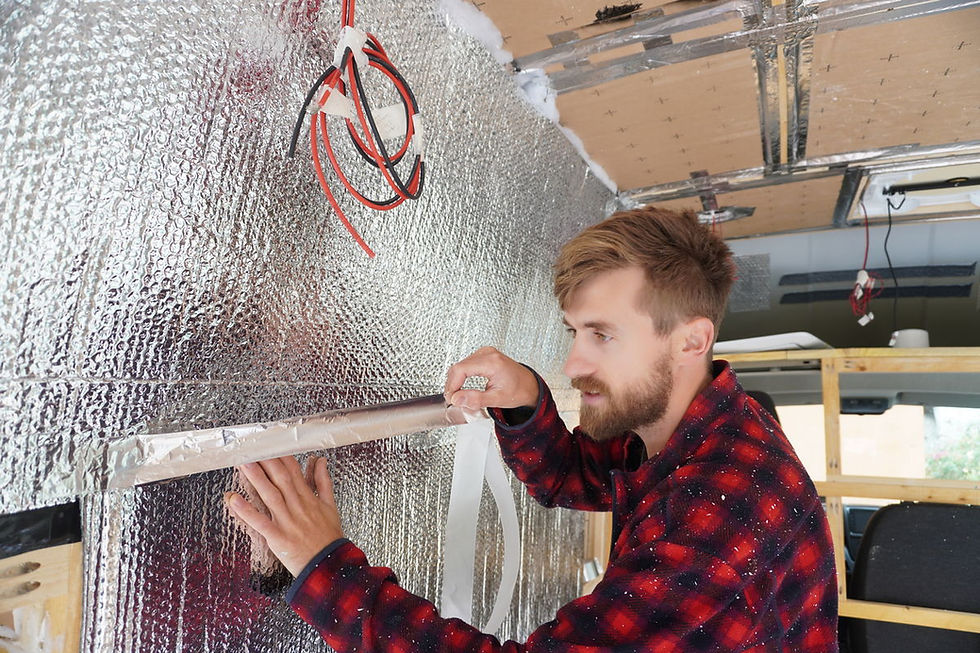
Our campervan vapour barrier installation was very detailed; we spent a total of three full days on it working as a pair. Every cavity where air contacts insulation is covered, be it foam board, recycled plastic wool, or expanding foam. We meticulously taped all seams closed, as well as covering all holes that penetrate structural members in the walls and doors. We fully wrapped the wheel arches, sealed the window frames, and taped up the seams where the walls meet the floor. We even sealed around wire entry holes with foil tape. We ended up using all three 1m x 7m rolls of SuperFOIL and 130m of foil tape. In the finished product, the only exposed materials in the van are:
Foil wrap
Foil tape
Bare van metal
The impermeable plasticised paper backing of foam board insulation
Front surfaces of wooden battens which aren't in contact with cold metal

This is what we mean by a perfectly detailed vapour barrier installation. It took a long time, a lot of attention and perfectionism, and a lot of foil tape. We're happy that any water vapour ingress through inperfections in our vapour barrier will be insignificant, and that all our insulation will be protected in the long term. If you're not confident that you can detail a vapour barrier to this level, then we'd encourage you to go for a vapour-open, breathable installation instead.
Two Viable Campervan Vapour Barrier Strategies for Your Build
We'll now bring all the theory together and recommend two build strategies, finally answering the question: 'what are vapour barriers good for?'. We'll start with our default recommendation, which is a vapour-open, breathable assembly.
Breathable, No Vapour Barrier Build
For most vanlifers, a vapour-open, breathable build is the simplest, lowest-risk option. Instead of trying to create a perfect plastic bubble, we accept that some moisture will move into the wall and design the assembly so it can tolerate it and dry again. What we try to avoid is airflow into cavities backed by cold metal. Draughts of humid air into these areas drives condensation against the metal, and this is what we want to minimise. On the other hand, the whole thing isn't hermetically sealed, so moisture can still passively diffuse out of the structure with heat and ventilation.
In practice, that means using moisture-tolerant insulation and focusing on airtightness and ventilation, not on adding a polyethylene sheet. Materials like 3M Thinsulate, plastic wool (recycled PET/polyester batt insulation), and polyiso board insulation are good candidates. They don’t slump when damp, they don’t readily rot, and they allow a bit of hygric buffering, meaning they can absorb some moisture and then release it again as the relative humidity drops. You can insulate your whole van with a combination of board and batt insulation; boards for big panels, batt for cavities and awkward spots.

In a build like this, you focus on airtightness rather than full hermetic vapour sealing. This means eliminating big cavities and treating your finished wall lining, which is usually wooden cladding in some form, as an air barrier which keeps draughts from getting into cavities you're not able to block up.
Wide panels are covered with batt or board glued directly to the metal, aiming for full contact so there aren't any empty cavities between the insulation and the metal.
Cavities you can reach into, like the big cavities where walls meet the floor and ceiling or the pillars at the rear of your van, are filled with batt insulation. Don't compress it tightly; the goal is to completely fill in the cavity with fluffy, air-trapping insulation.
Cavities that are too tight to get batt into should be left empty, as spraying foam into these will never result in a perfect fill and can create pockets that moisture gets trapped in.
At gaps where plywood panels meet, use foil tape, or silicone sealant to close up the gap, blocking the free flow of air into cold spaces backed by bare metal. Fit your decorative trim on top to hide the seal.
Skirting, corners, and furniture joints can also be closed up with wooden trim, again blocking airflow into cold cavities.
Any gaps around windows, fans, inlets, cable, and plumbing routes should be taped or sealed up, as these are also crevices where air can flow against bare, cold metal.
Flexible grommets are also a good solution for cable and plumbing exit points.

This system minimises draughts into cold areas without sealing everything off. We pair it with a strong ventilation system. For most builds, that’s at least one 12V roof fan over the living/cooking area, plus the fixed high- and low-level vents required by the leisure vehicle regulations and at least one opening window. Run the fan whenever you’re cooking, drying kit, or breathing in there for hours, and sleep with the fan gently extracting and a lower-level vent or window open. That combination keeps indoor relative humidity under control and continuously wicks airborne moisture outside before it can accumulate in the walls.
For typical use, like three-season touring, holidays, weekend trips, and even full-time use outside of deep, dark, wet and snowy winter, the moisture load is intermittent. You get wet evenings and steamy dinners, but then you have long, dry periods with good airflow. In that context, a vapour-open, airtight, and well-ventilated build lets assemblies get a bit wet and dry out effectively.
Still figuring out your van build?
This is where most people get stuck — jumping between blog posts, YouTube videos, and forums, never quite sure what to do next.
The Van Conversion Mastery Course gives you a clear, step-by-step system to design and build your van from start to finish — without the guesswork.

Detailed Smart Vapour Control Layer
If you’re living in the van full-time in the UK, the Pacific Northwest, or chasing winter sports all season, the moisture load is simply higher: more wet kit, more indoor cooking, longer stretches with windows shut and the heater running. In that context, a smart vapour control layer (VCL), rather than a simple Reflectix-style vapour barrier, can give you an extra safety margin compared to a purely vapour-open build, provided you install it carefully.
A smart VCL is more forgiving than plastic sheeting if a little moisture inevitably gets into the assembly, because it tightens up and behaves like a strong vapour retarder in cold conditions, then opens up to let vapour through when things warm up outdoors. This allows the now-warm metal of your van to drive inward drying out of the insulation and back into the van where your ventilation whisks the vapour away. We recommend purpose-made, variable-permeability membranes such as Pro Clima Intello/Intello Plus or SIGA Majrex 200.

Plastic bubble-foil like Reflectix, on the other hand, blocks all passage of moisture in all contexts. This would be fine if it were possible to create a perfectly hermetically sealed membrane inside a van. As we've explained previously, we think this is very difficult to do. We'd be concerned about recommending Reflectix to our readers for that reason, and we prefer the forgiving nature of a smart VCL.
As building scientist Joseph Lstiburek points out, assemblies need a drying path; putting vapour-impermeable layers on both sides prevents any moisture that gets in from ever drying to either side. In a steel-skinned van, the metal is already a zero-perm outer layer, so adding another impermeable inner layer (like taped Reflectix) is asking for a moisture trap. A smart VCL is more forgiving if a little moisture inevitably gets into the assembly, because under warmer, drier interior conditions it can open up and let that moisture diffuse backout of the insulation.

However, your smart VCL still must be installed as a continuous air and vapour control layer: air leaks move far more moisture than diffusion. Manufacturer guidelines for Intello and Majrex are clear that you need taped laps (100mm overlaps), sealed edges to adjacent surfaces, and airtight treatment of penetrations to get the advertised performance. In practice, you'll be installing the same highly-detailed membrane that we discussed in the 'What We Did' section above. We'll go over this process in a later section.
Done this way, a smart VCL gives winter-heavy users the benefits of an interior vapour barrier without the same risk of long-term moisture trap you’d get from Reflectix or ordinary plastic foil sheeting in front of a steel shell.
Materials and Components: What Are Vapour Barriers Built From?
If you've decided to go the smart VCL route, we'll show you how to go about your installation, starting with a supplies list.

Smart VCL Membrane Material
We used 21m of 1m wide Reflectix for Shane's L3 H3 Citroen Jumper, so a single roll of either one of these should be sufficient.

High-adhesive Impermeable Tape
High-adhesive aluminium tape is cheaper and often recommended for Reflectix installation, but we've noticed that it's starting to peel a couple of weeks after we put it in.
We used 130m for our build.

Flexible Adhesive Sealant
Flexible adhesive sealant for bonding the membrane to timber and metal.
Pro Clima and SIGA recommend their own system adhesives for use with their smart VCL membranes, but Sikaflex 522 is flexible and vibration resistant, and we prefer it for van use.

Staple Gun and Staples
You can also use a staple gun for fixing the membrane to battens; we made heavy use of our staple gun for this purpose, as it's quicker and cleaner than sealant.


How to Install a Vapour Barrier in Your Van
In this section, we'll go over the process we used to install our Reflectix vapour barrier in Shane's van. As we've said, we recommend a smart VCL over Reflectix, but we were very thorough with our installation and would use the exact same process for installing a smart VCL.
Phase 1: Big Panels
The goal throughout this process is to minimise the number of joints and laps between panels of membrane, so try to use the biggest sheets you can. Wooden battens are the most solid and convenient attachment points, so measure between battens and cut your membrane material to size.

This is why we recommend a long straightedge for such work, as it allows you to accurately draw and cut along long lengths of sheeting.
Staple or stick the edges of your sheeting to your battens, stapling at equal intervals. One staple every 20-30cm is ideal.

As you put your panels of sheeting in place, seal up the edges with your chosen high-adhesive impermeable tape. This is where detailing comes in: every open gap that lets air into a cavity or behind your VCL sheeting is a place where moisture can get in. Pay close attention to both the edges of your sheeting and any holes in your van's hollow structural pillars and beams. Be liberal in your use of tape to seal up these gaps.
Phase 2: Fiddly Bits
With the big panels covered, it's time to seal up all the nooks and crannies, irregular shapes, and spots between the big sheets you've got in place. We're going for full coverage here, so again it's time to apply your eye for detail. We installed a flare in Shane's new van which we've lined with insulation. Sealing these up with vapour barrier involved a lot of cutting and measuring small shapes and meticulously taping up irregular corners and edges.

If you've insulated your wheel arches, these need to be sealed too, including the odd-shaped triangular spots behind the angled parts of the arch.

Finally, seal up the spots where cables penetrate the vapour barrier. We used flexible, plastic-backed aluminium tape for this, but rubber grommets are specifically designed for the purpose and probably give a better finish.

Phase 3: Doors and Windows
Your van should be looking pretty spacey by this point. The final stage of the campervan vapour barrier process is to seal up your doors and windows. You should be able to use big individual sheets to seal up the panels in your doors. Again, fiddly bits and penetrations around interior handles and unlatching buttons need to be carefully taped.

If you've installed windows, there will be cracks and crevices between the window frames and the surrounding van metalwork. Make sure these are all taped up. Again, pay attention to holes that give access to interior cavities; van doors are rife with these. Cover them with tape to exclude moist air.

Phase 4: Detail Check
Your van's interior should now be entirely covered in VCL sheeting, with the only exposed materials being sheeting, painted metal, wooden battens, and the plasticised paper backing of polyiso board. Take time to carefully check all your tape, all your VCL sheet edges, and all irregular shapes in your van. Patch up gaps and holes, treating the process like you're about to spray water all over the inside of your van. Anything that wouldn't hold water needs taping up.

You'll notice in these photos that our bulkhead separator has some big holes in it. That's because those holes are either 1) a tricky shape which we'll fill in with custom woodwork when we come to cladding, or 2) space left for a cab-access window. We'll go back and put a vapour barrier over those elements once we've installed them.
Note also that we've not vapour barriered the floor. This is because:
The floor is only insulated with polyiso board, which doesn't take on water
The floor is likely to accumulate actual liquid water from wet shoes, dripping clothes, splashes from the sink, possible plumbing leaks etc. We'd rather leave the floor fully breathable so that we're not paranoid about it retaining this spilled water over the long term.
For a close look at exactly how we build our campervan floor, take a look at our step-by-step guide.

Final Thoughts
We've covered a lot in this article, but we hope that it's a fairly comprehensive resource on the subject of campervan vapour barriers. The take home point is this: only install a vapour barrier if you'll be subjecting the inside of your van to high vapour loads. That means heavy or full-time use for winter sports or in parts of the world that see low temperatures, high rainfall, and a humid climate for much of the year. If that matches your use-case, go with a smart VCL over simple plastic foil like Reflectix. A smart VCL is forgiving in the almost-inevitable case where you don't manage to install a perfectly sealed, comprehensive membrane. These materials let moisture back out of your walls when ventilation and temperature encourages evaporation. Reflectix-type materials do not, and an imperfect seal using them likely does more harm than good.
Don't forget to check out our articles on insulation and ventilation to learn more about these important aspects of your van build. Now that your vapour barrier is in place (or not), it's likely time to move on to flooring and cladding.
Planning your van conversion?
Start with the free Van Conversion Diagram Pack below.
Want a clear step-by-step path for your full build?
The Van Conversion Mastery Course walks you step-by-step through the entire build process — from planning and layout to electrics, insulation, water, gas, carpentry, and more.
Until next time.
