
A Complete Guide to Caravan Water Inlet Sockets (2026)

Updated: Apr 8
A water inlet in the side of your van is a wonderful luxury. It's far easier to fill up water via an easily-accessible refill point on the outside of your van than via your water tank's inlet. In this guide, I will show you the simple approach to installing a caravan water inlet socket in your van. We will examine two of the most popular options: the Truma water inlet housing and the Whale water inlet socket.

Shane is an NCC-certified electrical installer.
He has built, taught, and lived in campervans since 2019.
This post contains affiliate links. We may earn a commission at no extra cost to you. To understand our policies on content, affiliate commissions, and liability, please review our Terms of Use.

In this guide
Supplies List
 | For driving and drilling |
 | For protecting bare metal from rust |
 | Sikaflex 522 sealant For sticking the inlet to the side of your van and forming a watertight seal |
 | For keeping the hole saw lubricated |
 | For cutting circular holes in wood and metal |
 | |
 | Metal file For smoothing cut metal edges |
What is a Caravan Water Inlet Socket For?
A caravan water inlet socket is an integral part of your water system. It connects directly to your fresh water tank (usually with PEX piping). This means that you can install your water tank in the most ideal location without worrying about keeping it accessible for refilling. Note that a caravan water inlet socket operates by gravity, so the socket must be installed higher than the top of the water tank.

A caravan water socket allows you to conveniently fill your tank with water from a water filling station at a campsite or motorway services. Further, specialised inlets like the Truma water inlet housing or the Whale water inlet socket allow you to connect your campervan to a campsite's pressurised mains water supply. This gives you pressurised plumbing in your campervan that works exactly like your water at home.
For a detailed explanation of every element in a campervan water system, check out our comprehensive guide.
The Truma Water Inlet Housing
A very popular caravan water inlet socket is the Truma water inlet housing. It's great for people who spend longer lengths of time at campsites as it allows for a fixed, pressurised water hook-up. This means you can keep it connected to the mains water supply indefinitely and run the taps as long as you like.
The Truma water inlet housing is very easy to install and known to be particularly leak-proof due to the pistol grip type and double o-ring fitting.

The Whale Water Inlet Socket
Another very popular caravan water inlet socket is the Whale water inlet socket. Like the Truma inlet, it's leak-proof and allows for a pressurized water hook-up. It's easy to install and connects particularly well with other Whale products (many of which I used in my campervan water system).

How to Use a Hole Saw
You will need to use a bi-metal (metal cutting) hole saw drill attachment to cut a circular hole in the side of your van for your water inlet.

There are a few things you should be aware of when using a bi-metal hole saw:
Oil: Use tapping and cutting fluid (e.g. WD40) liberally on the metal you're cutting. The high friction will destroy the hole saw otherwise.
RPM: Use the drill on a low RPM (rotations per minute) to keep friction low. This means that you shouldn't press your finger all the way down on the trigger of the drill.
Pulsate: Pulsate the drill while you are cutting. Using a stop and start motion while drilling gives the hole saw a chance to cool down.
Don’t cheap out: Real bi-metal hole saws cost a bit of cash - the cheap ones you find online may not work as well or at all.
Be careful of the swarf:
When using mechanical tools on metal, a lot of metal shavings are produced (known as 'swarf'). It is vital that you remove all these shavings from the van when you are finished. If you don't, they will very quickly rust and damage your vehicle.
Always wear eye protection while using mechanical tools on metal. Swarf can cause real damage if it gets in your eyes.

Learn from my mistakes; the first time I used a hole saw, I destroyed it within 5 minutes because I didn't follow the above advice.
How to Install a Caravan Water Inlet Socket
There are many inlets we may need to install in a campervan, including (but not limited to):
Water inlet socket
A caravan water inlet socket allows you to fill up your water tank via a hose in the side of your van. In the Roaming Home study, we found that 39% of vans have a permanent water filling inlet installed.
The process of installing a water inlet socket is the same as installing a mains hook-up socket, and very similar to the solar cable entry installation.
Step 1: Choose a bi-metal holesaw
Choose a bi-metal hole saw that fits your chosen caravan water inlet socket. Check the specific dimensions of the inlet you are using. Choosing the right size hole saw is important.
Step 2: Trace around the hole saw
Place the hole saw on the van and trace around it with a sharpie or pencil.
Step 3: Drill pilot holes
Drill a pilot hole in the middle of the traced circle and two more pilot holes close by on either side.

Step 4: Tape some plywood
Tape a square piece of plywood to the side of the van to cover the holes you just drilled. This will act as guidance for the hole saw as it makes the hole so it doesn't wander and damage the paintwork.

Step 5: Secure the plywood
Screw into the piece of plywood from the outside to secure it to the van.

Step 6: Use the hole saw
Attach the hole saw to your drill and cut a hole in the side of the van.
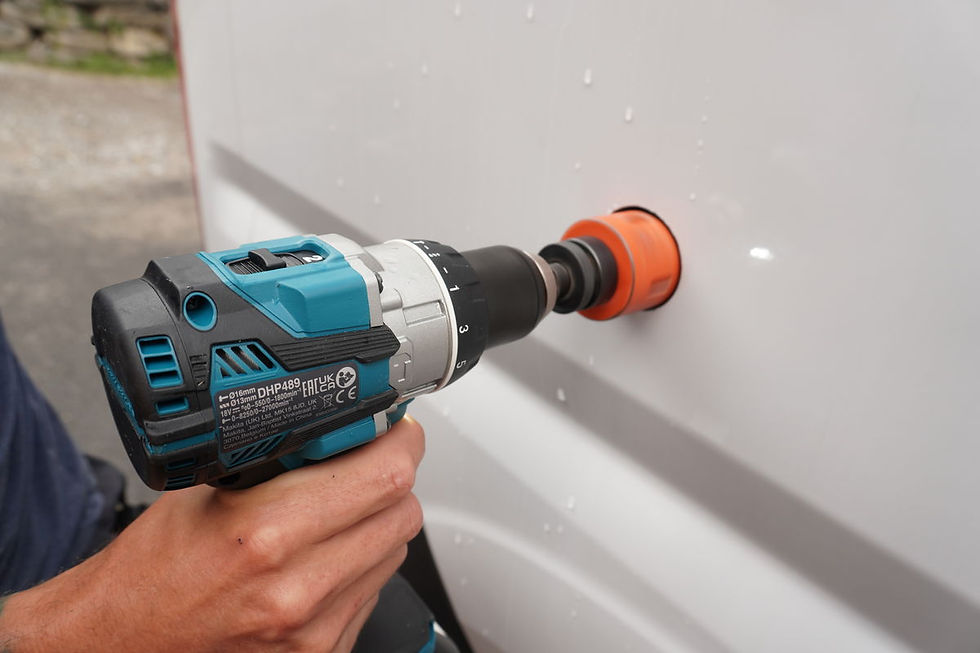
Step 7: Treat the cut edges with a file and metal paint
Use a file to file away burrs, swarf, and sharp spots. Then, apply anti-rust metal paint to the cut edges.

Step 8: Insert the inlet
Place the caravan water inlet socket into the hole you've just cut and mark with a pencil where the screws go in. Then take it out again.
Step 9: Drill pilot holes
Drill four pilot holes on the pencil marks.

Step 10: Secure the plywood to the van (optional)
Depending on the inlet, the plywood will be the backing flange of the inlet. Secure the plywood to the inside of the van with sealant. Clamp the plywood to the van until the sealant has dried and cured.

Step 11: Attach the caravan water inlet socket
Screw the caravan water inlet socket into the van from the outside.
Step 12: Apply sealant
Run a bead of sealant around the inlet to prevent any leaks.

Conclusion
I hope you found this guide to installing a caravan water inlet socket useful. You are well on your way to a beautiful self-build campervan. The next step might be to install a sink, shower, or water filter. For a detailed guide on water systems as a whole, check out our guide.
Planning your van conversion?
Start with the free Van Conversion Diagram Pack below.
Want a clear step-by-step path for your full build?
The Van Conversion Mastery Course walks you step-by-step through the entire build process — from planning and layout to electrics, insulation, water, gas, carpentry, and more.

Until next time.


