
FOSSiBOT F2400 In-Depth Review: A 2048Wh Portable Power Station for Backup and Car Camping (2026)

Updated: Aug 31
A portable power station earns its place in a campervan in one of two ways. Either it's a second, independent electrical system that you can wheel out when your leisure batteries are low, take outside to the picnic table, and use to run mains appliances without firing up your inverter. Or it's the whole electrical system; the entire leisure battery, inverter, solar charge controller and fuse box collapsed into one box, for people sleeping in a car or simpler van with no bespoke electrical system.
FOSSiBOT sent me their F2400 to test, and it turns out to be unusually good at both jobs. It's a 2048Wh LiFePO₄ battery with a 2400W pure sine wave inverter, thirteen ports, and — crucially for vans — a regulated 12V/25A DC outlet that most of its rivals don't have. In this review, we'll look at what the F2400 actually is, how it's built, what goes in and what comes out, how quickly it charges by each of its three methods, how long the battery really lasts under a normal working week in a van, and how it stacks up against the Bluetti Elite 200 V2 Shane tested last winter, plus current offerings from EcoFlow and Anker.

Shane is an NCC-certified electrical installer. He has built, taught, and lived in campervans since 2019.
The context of this review: FOSSiBOT provided the F2400 for testing. They had no input on the testing, the content, or the verdict, and haven't seen this article. What follows is my honest assessment after a week of hands-on testing here in the Alps.
This post contains affiliate links. We may earn a commission at no extra cost to you. To understand our policies on content, affiliate commissions, and liability, please review our Terms of Use.

In This Guide
In a Nutshell
The FOSSiBOT F2400 is a 2048Wh portable power station with a 2400W pure sine wave inverter (4800W surge), built around EVE LiFePO₄ cells rated for 4000+ cycles to 80% capacity and backed by a 5-year warranty. It weighs 22kg, measures 386 × 284 × 321mm, and sells for £649 direct from FOSSiBOT.
The van-specific standout is a regulated 12V/25A DC outlet alongside the usual 10A cigarette socket. That's enough headroom to run a genuine campervan DC circuit; a compressor fridge, LED lights, a roof fan and a water pump, which the 10A-limited competition simply can't.
Charging is quick. I measured a real-world 768W average input from mains, which puts a full charge from empty at about 2 hours 40 minutes.
Battery life is genuinely long. At the ~48W load I measured with a laptop, headphones and a wireless charging pad running, a full battery gives roughly 43 hours.
The input dial; 300W to 1100W in five steps, is the feature nobody else in this class offers, and it matters more for vans than FOSSiBOT seem to realise.
The hinged port covers are poor. Everything else feels solid; these feel like they came off a different, cheaper product.
For discounts on FOSSiBOT products exclusive to TVC readers, take a look here:
F2400, Original Price: £999.00, Coupon: YTM24SM, Coupon Price: £599.00
F1200, Original Price: £599.00, Coupon: YTM12SM, Coupon Price: £339.00
F3600 Pro, Original Price: £2,199.00, Coupon: YTM36SM, Coupon Price: £1,199.00
SP200W, Original Price: £399.00, Coupon: YTMSP2SM, Coupon Price: £179.00
SP420W, Original Price: £599.00, Coupon: YTMSP42SM, Coupon Price: £359.00

Why You Might Want a Portable Power Station at All
Before we get into the F2400 specifically, it's worth being clear about the two quite different problems a unit like this solves, because they lead to two quite different buying decisions.
As backup for a van that already has electrics
If you've followed our guide to sizing a campervan electrical system, you'll have built in a buffer: two or three no-charge days, a battery bank sized at 2× or 2.5× your daily usage. That buffer is there for a reason, and the reason is that the buffer sometimes runs out. A few situations where it does:
A week of bad weather. You park up somewhere good, the cloud comes in, and your solar array produces a fraction of what it should for five days running. Between October and March in the south of England, total solar generation is about a quarter of what it is between April and September, as we cover in our article on tilting solar panels. In the mountains, with short days and shading, it can be worse.
You're not driving. Your DC-DC charger is often the single biggest charging source in a van, and it only works when the engine is running. Park up for a week's skiing or a week's climbing and that input drops to zero.
Something in the system fails. A solar charge controller packs up, a fuse blows somewhere inconvenient, a battery develops a fault. You'd like your fridge and your laptop to carry on working whilst you sort it out.
You want to use mains power outside the van. Running an extension lead out of the sliding door from your inverter works, but it's a faff, and it means your inverter is on and idling the whole time.
That last point is the one I'd underline. Most van inverters draw something on standby, usually a few watts to a few tens of watts depending on the model, and every AC device you charge goes through a DC to AC to DC conversion with losses at each step. A power station with four USB-C ports lets you charge laptops and phones directly DC-to-DC, no inverter involved. Over a working week, that adds up.
As the whole system, for car campers and less-equipped vans
The second case is completely different. There are a lot of people sleeping in vehicles that will never have a fixed electrical system: Berlingos and Partners and Caddys with a bed board in the back, estate cars with the seats folded, hire vans on a two-week trip, and people at the very beginning of a build who haven't got as far as the electrics. For those people, the calculation isn't "do I want a backup" but "do I install a system at all".
A modest fixed system (100Ah AGM battery, 200W of solar, a 20A MPPT controller, a split charger, busbars, fuses, switches and wire) comes to roughly £800, and that's before you've spent a weekend cutting holes in the roof and routing cable through conduit. The F2400 is £649, arrives in a box, and works the moment you plug something into it.
You give up automatic alternator charging, permanent solar, and the ability to replace one component when it fails rather than sending the whole thing back. What you get is a system with no installation, which you can take out of one vehicle and put into another, and which you can carry into a café or a friend's kitchen to charge.

What Is the FOSSiBOT F2400?
At its core, the F2400 is a 2048Wh LiFePO₄ battery with an integrated 2400W pure sine wave inverter, an MPPT solar charge controller, a BMS, and thirteen output ports, all in one box. It's the middle of FOSSiBOT's range, sitting above the 1024Wh F1200 and below the 3840Wh F3600 Pro.
To put 2048Wh in van terms: that's equivalent to about 160Ah at 12.8V, or roughly the usable capacity of a 200Ah lithium leisure battery discharged to 80%. That's a meaningful chunk of a medium-sized van system: the 'Civilised Van' spec in our electrical system sizing guide is built on exactly that battery.
The cells are EVE LFP, rated at 4000+ cycles to 80% of original capacity. Cycle a unit like this fully every single day and that's about eleven years; in reality you'll be using 20–50% and topping up, so the battery will comfortably outlast most van builds.
FOSSiBOT back it with a 5-year warranty, which matches the best in the category. If you want the background on why LFP is the chemistry you want here, our article on lithium leisure batteries covers it.
The headline features, in brief:
2048Wh capacity, LiFePO₄, 4000+ cycles
2400W pure sine wave inverter, 4800W surge
1100W maximum AC input, adjustable in five steps via a physical dial
500W maximum solar input, 11.5–50V, MC4 connectors
1600W maximum combined input (AC + solar simultaneously)
8ms UPS switchover
13 ports, including a regulated 12V/25A DC outlet
Simultaneous charge and discharge
Bluetooth and WiFi app control
22kg, 386 × 284 × 321mm
5-year warranty
Design and Build Quality
What's in the box
The F2400 arrives with everything you need to charge it three ways: a 1.5m AC power cord, a 1m solar charging cable with MC4 connectors, a 1m vehicle charging cable for a cigarette socket, and the manual. There's no external power brick: the charging circuitry is built into the unit, so the AC cord goes straight from the wall into the side of the machine. That's a small thing that makes a real difference when you're hauling the unit somewhere to charge it.
Better still, all three cables stow in a compartment in the top of the unit under a hinged lid. I've lost count of the number of times I've arrived somewhere with a device and not the cable for it, so a dedicated home for the leads is a really thoughtful bit of design.

The physical object
The F2400 is a good-looking device, which shouldn't matter but does. The case is a matte finish in dark grey with green highlights in my version, with rounded edges and corners throughout. It looks classy, and the matte surface doesn't show fingerprints.
More importantly, everything is labelled clearly, and labelled in the right place. The warnings telling you to keep the fan covers open whilst the unit is running are printed on the fan covers themselves. Port groups are labelled at the group. The result is that you can lift it out of the box and work out how it operates without opening the manual. Given what we've said in the past about Dometic's instructions, is worth applauding when a manufacturer gets this sort of thing right.
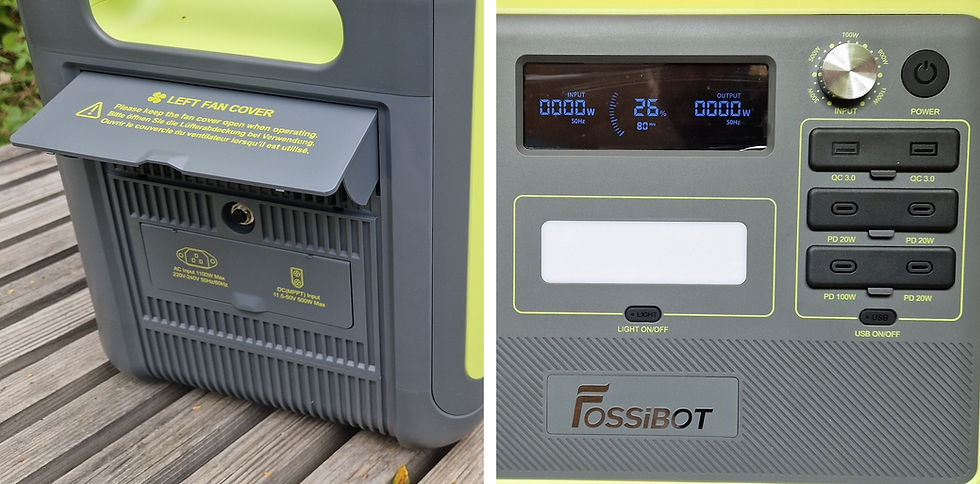
Build quality is, for the most part, excellent. The handles are moulded into the body rather than folding out or clipping up, so there's nothing to deploy and nothing to break, and they feel completely solid under load. Ports accept cables with a satisfying clunk and hold them with a bit of resistance, which is exactly what you want in a vehicle where things get shaken about. The buttons click properly. Turning functions on and off, and connecting over Bluetooth, gives you a little feedback bleep: a small touch that makes the device feel responsive.
At 22kg it's heavy, but manageable, and the moulded handles make it more manageable than the weight alone suggests. I'd say it's about the practical limit for one person carrying it any distance. It's also impressively compact for what's inside it: at 386 × 284 × 321mm it isn't much bigger than a 100Ah leisure battery, and it's completely self-contained, including all necessary charging cables.

The display
The LCD display is excellent, and I found it was all I needed for using the device. It shows charging status and discharging status with little icons indicating how it's being charged and discharged, and whether the inverter is on. It gives you a time until fully charged and a time until fully discharged, both context-sensitive and both updating in real time as inputs and demand change. Plug something in and watch the estimate drop; unplug it and watch it climb again. It also shows the precise wattage of every input and output, which is far more interesting than it sounds: it's the easiest way I've found to learn what your devices actually draw, and that's the first step in calculating your daily electricity usage properly.
There's also a built-in lamp, which is bright and a pleasant warm yellow rather than the harsh blue-white you often get. It has flashing and SOS modes on repeated presses. Plenty of competing power stations in this class don't have a light at all; Shane noted its absence as a downside on the Bluetti Elite 200 V2. When you're carrying 22kg through a dark car park, having a built-in lamp is welcome.

Ports: What Goes In and What Comes Out
The F2400 has 13 ports on the EU/UK model, and they're grouped sensibly and close together rather than scattered around the case.
Outputs:
3 × AC sockets (230V, 2400W total, pure sine wave)
1 × USB-C at 100W Power Delivery
3 × USB-C at 20W Power Delivery
2 × USB-A at 18W (QC3.0)
1 × 12V/25A DC "RV" outlet (XT60)
1 × 12V/10A cigarette lighter socket
2 × 12V/3A DC5521 (5.5mm) outlets
Inputs:
AC charging input, up to 1100W
Solar input, up to 500W, 11.5–50V, MC4
Car charging input via cigarette socket, 12V or 24V
Every one of the DC outputs is regulated, which matters more than the spec sheet makes it sound. Unregulated 12V outputs sag as the battery drains, and some 12V appliances get unhappy about that. Regulated means you get a steady 12V regardless of state of charge.
The 12V/25A outlet is the important one
Here's where the F2400 does something its competitors don't, and it's the single most van-relevant thing about it. When Shane reviewed the Bluetti Elite 200 V2, his sharpest criticism was that its DC side is limited to a 10A cigarette socket. As he put it, that's fine for a phone or a single fridge, but nowhere near what a campervan DC circuit needs. Run the numbers on a typical van: a compressor fridge at 4–6A, a diesel heater that can spike to around 8A on ignition, a roof fan at 3A, LED lights at 1–2A, plus a water pump and a router. That's comfortably over 10A, which means on a 10A-limited unit you're forced to run most of it through the inverter on AC: inefficient, and slightly absurd.
The F2400's 12V/25A regulated outlet is 300W of DC headroom. That's enough for the whole list above with room to spare, which means that for a car camper or a halfway-house build, you could genuinely wire a small 12V fuse box off this outlet and run a proper DC circuit from it. Nobody else in this price class offers that.
One safety note, because it's a 25A feed: if you're running a DC distribution circuit off that outlet, fuse it properly at the power station end and size your cable for the full 25A over the run length. Our mega guide to wires for campervans and the wire sizing calculator will get you there. The outlet being regulated doesn't remove your responsibility for the wiring downstream of it.

The BrightEMS App
The app is called BrightEMS, not anything FOSSiBOT-branded, which is worth knowing before you go hunting the app store for "Fossibot", which brings up a smart home control app instead. The BrightEMS controls connection to the F2400 over both Bluetooth and WiFi.
Setup was easy. Power the unit on, open the app, and it finds the F2400 in seconds, with the little confirmation bleep from the machine that I've come to like. The dashboard is simple and shows device status, input and output, and state of charge.
It is not a deep piece of software. There's no usage history and no automation, and there's no equivalent of Bluetti's Power Lifting mode for running appliances above the inverter's rated output. What it does have, and what I think is the most useful setting in it, is adjustable maximum charge and discharge levels. Setting a maximum discharge of around 10% and leaving it there is one of the easiest things you can do to extend the life of a lithium battery over years of use, and it's good to see it exposed rather than buried.

Like Shane's verdict on the Bluetti app: the hardware is the point here, the software is fine. I'd rather have a good physical dial and a good screen than a beautiful app, and that is more or less exactly the trade FOSSiBOT have made.
Still figuring out your van electrics?
This is where most people get stuck — trying to piece everything together from scattered advice, second-guessing cable sizes, fuses, and system design.
The Van Electrics Masterclass walks you through the entire system step-by-step — so you can design and install it properly, with confidence.

Charging the FOSSiBOT F2400
There are three ways in — mains, car socket, and solar — and you can use AC and DC simultaneously.
Mains charging
This is the fast one. I put the unit on mains at 25% charge and it was full in 2 hours. At that rate, a full charge from empty would take about 2 hours 40 minutes. FOSSiBOT advertise 0–100% in 2 hours at the full 1100W setting, and my measured rate doesn't quite match that. That's not a criticism of the unit so much as a reminder that headline charging figures assume everything is perfect. Either way, filling a 2kWh battery in under three hours is quick, and it means you can top up over a long lunch.
Car charging
Charging from the cigarette lighter socket whilst driving is much slower, as it always is. From 25%, it took 14 hours of driving to fill, which gives a full charge from empty of about 18.5 hours. FOSSiBOT quote 17 hours at 12V, so we're in the right ballpark. The limitation isn't the F2400, but that a cigarette lighter socket is typically fused at 10A or so and can only deliver 100–120W. Treat car charging as a trickle that tops you up over a long driving day, not as a way to fill an empty unit.

If you want meaningful charge whilst driving, the answer is a proper DC-DC charger feeding your van's leisure batteries, and then charging the F2400 from those.
Solar charging
The F2400 takes up to 500W of solar through an MC4 connection, with a built-in MPPT controller, at 11.5–50V. FOSSiBOT quote about 4 hours for a full charge at the full 500W in ideal sun.
FOSSiBOT sell their own panels: take a look at the SP200W 200W portable solar panel, and use the code YTMSP2SM at checkout to get it for £179, exclusive to TVC readers. For something bigger, check out the SP420W 420W portable solar panel, and use the code YTMSP42SM at checkout to get it for £359. Because the input is standard MC4 rather than a proprietary connector, you can use any panels that fit the voltage window. That's the right choice by FOSSiBOT and worth recognising.
Two things to note. First, 500W is the lowest solar input in this class: the Bluetti takes 1000W, the current EcoFlow and Anker units take 800–1000W. If solar is your primary charging route, that's a real limitation. Second, FOSSiBOT are explicit that you shouldn't mix panels of different wattages or voltages, as the mismatch can push current backwards into the lower-voltage panel and damage things.
Simultaneous AC and DC charging
You can run AC and solar at the same time for a combined maximum of 1600W, which FOSSiBOT claim brings a full charge down to about 1.5 hours. This is also where the "bidirectional inverter" claim earns its keep: the unit will charge and discharge at once, so you can have it plugged in and still be running loads off it.
The input dial and what it's actually for
The differentiator on this machine is a physical rotary dial that sets the AC input anywhere from 300W to 1100W in five steps: 300W, 500W, 700W, 900W and 1100W. It turns smoothly, and an appropriate screen comes up as you turn it showing you what you're setting it to. FOSSiBOT's own quoted charge times for each, under ideal conditions:
Input setting | Time to full |
1100W | 2 hours |
900W | 2 hours 40 minutes |
700W | 3 hours 20 minutes |
500W | 4 hours 30 minutes |
300W | 7 hours |
Now, why would you ever choose to charge more slowly? FOSSiBOT's stated reason is about weak supplies: when the incoming voltage is too low or unstable, dialling the input down lets the unit charge anyway instead of faulting out. That covers old campsite wiring, a long extension lead, and small generators.
But there's a second use case that matters far more in a van, and I think it's the real answer to why this dial is here: Charging the F2400 from your van's own leisure batteries. If you plug the power station into your van's inverter and let it pull the full 1100W, here's what your battery bank sees. Accounting for inverter efficiency at roughly 85%:
1100 ÷ 0.85 = 1294W drawn on the DC side
1294 ÷ 12.8V = about 101A
A hundred amps. That's a colossal draw on a leisure battery bank, and on a smaller system it will either trip your inverter's protection or hammer the batteries. Dial it down to 300W instead:
300 ÷ 0.85 = 353W; 353 ÷ 12.8V = about 28A
Twenty-eight amps is a load a 200Ah lithium bank can supply all day without complaint.
There's a third benefit too. The same logic applies to campsite hookups. At 230V, 1100W is only about 4.8A, so the F2400 alone won't trouble a 16A bollard. However, if you're also running a heater and a kettle from the same supply, being able to leave the power station a few amps of headroom stops you tripping the whole pitch. It's the same principle as Victron's PowerControl, which we cover in our MultiPlus wiring guide: cap what the charger draws so the rest of the system can have what it needs.
Finally, slower charging means less heat and less fan noise, and is marginally gentler on the cells over a long life. I've not seen this dial on any competing unit, and having used it, I think the rest of the category should copy it.

Battery Life: What Does 2048Wh Actually Get You?
The headline capacity is meaningless until you turn it into hours, so let's do that from measurements rather than marketing. At 28% charge, I plugged in a wireless charging pad for my phone, a set of headphones on USB-C, and my laptop, representing about 48W of combined draw. The screen showed 12 hours remaining at that rate. Scaling that to a full battery:
2048 ÷ 48 = 42.9 hours
So at a fairly typical "working in the van" load, a full F2400 gives you roughly 43 hours. Drop the wireless pad and just run a laptop and a phone charger, and you're looking at a bit longer: call it the best part of two days of continuous use, which for most people is closer to four or five days of actual use.
A realistic working week
Let's build that out into something more useful, the way we do when sizing a van electrical system. Here's a working day for a couple travelling and working remotely: two laptops, two USB devices, a portable hotspot, and occasional camera and speaker charging:
Device | Power | Hours/day | Daily use |
2 × laptop (via USB-C PD) | 120W | 4 | 480Wh |
2 × USB devices (phone, headphones) | 20W | 2 | 40Wh |
Portable wi-fi hotspot | 7W | 10 | 70Wh |
Camera battery (occasional) | 20W | 1.5 | 30Wh |
Bluetooth speaker (occasional) | 15W | 2 | 30Wh |
Total | 650Wh |
650Wh a day is 32% of the F2400's capacity, giving:
2048 ÷ 650 = 3.15 days
So just over three days of two people working off the unit before it needs a charge. And note that every single one of those loads runs on DC, through the USB-C and USB-A ports, with no inverter involved and none of the associated conversion losses. That's the efficiency argument for a power station with good USB-C provision, and it's why the F2400's four USB-C ports are more useful in practice than a bigger inverter would be. If you're only one person with one laptop and phone, you'd get close to double this runtime.
Add a compressor fridge at 250–500Wh a day off the 25A outlet and that three days drops to about one and a half. Which is a fair summary of where a 2kWh unit sits: plenty for devices, tight for a fridge, brief for anything with a heating element.

The Inverter: Mains Power Without Your Van's Inverter
The F2400's inverter is rated at 2400W continuous with a 4800W surge, and it's activated by a single button press. I tested it by making a cup of tea in an electric kettle, which is the sort of load that makes most van electrical systems flinch. It ran without any hesitation at all. Power delivery was instant: no soft start, no lag, no sagging as the element came on. The unit simply supplied what the kettle asked for. The screen showed the kettle pulling 1016W, and the time-remaining figure dropped from hours to 25 minutes: I was at 23% charge at the time. That's a slightly alarming number to watch appear, but it's a good test of whether the display is being honest.
23% of 2048Wh is 471Wh. At 1016W, that ought to give you:
471 ÷ 1042 = 0.46 hours, or about 27 minutes
The unit said 25, which implies it's quietly accounting for about 92% efficiency rather than quoting the theoretical best case. I'd much rather have a display that's slightly pessimistic than one that flatters itself, and it's a small sign that the estimates on this machine can be trusted.

But 25 minutes is the wrong way to think about a kettle, because nobody runs a kettle for 25 minutes. The useful thing about kettles is that the energy to boil water is more or less fixed regardless of how powerful the element is; a bigger element just gets there faster. Heating half a litre from 15°C to 100°C takes about 178kJ, which is 49Wh, and allowing for around 85% efficiency in a real kettle, call it 58Wh per boil. At 1042W, that's about three and a half minutes of running, and:
58 ÷ 2048 = 2.8% of the battery
Or, put another way, about 35 boils from a full charge. Two mugs of tea costs you under 3% of your capacity, which I think will surprise people who assume a kettle is off-limits off-grid. The lesson here is a general one for anyone reading a power station's time-remaining figure: a big number on the display is about the rate of draw, not the size of the job. A 1042W load looks terrifying until you remember you only need it for three minutes.
The 4800W surge headroom also means high-inrush appliances (anything with a motor or a heating element) start without tripping anything. The 2400W rating covers essentially any single appliance you'd put in a van: an air fryer, a hair dryer, a coffee machine, corded power tools. The only thing it won't handle is a full-size induction hob at full tilt.
Pure sine wave and the UPS function
The inverter is pure sine wave, which is the same clean waveform you get from the grid, as opposed to the blocky modified sine wave that cheaper inverters produce. It matters for anything with a motor, a transformer, or sensitive electronics: laptops, camera gear, routers, CPAP machines. Modified sine wave can make motors run hot and audio equipment buzz, and some devices simply refuse to work with it. Our full inverter guide goes into the difference in more detail.
The F2400 also supports UPS mode with an 8ms switchover. Plug the unit into the wall and plug your equipment into the unit, and if the mains drops, the battery takes over in eight milliseconds: fast enough that a computer won't notice. Eight milliseconds is, for what it's worth, quicker than the Bluetti's quoted 15ms. For van use, this is more relevant than it first appears. If you're on a campsite hookup, running your sensitive gear through the F2400 means a flaky bollard or a tripped RCD doesn't cost you your work. And in a van with a fixed system, it means the F2400 can hold up critical loads like a fridge whilst you diagnose a fault in the main system.
Weatherproofing and Noise
I hadn't planned to test the weatherproofing, but I got caught in a shower whilst the unit was outside and running, so here we are. It carried on without a flicker despite getting quite wet. The DC and USB ports have rubber plug covers, and the fans are protected by a three-sided cover which kept them completely clear of water that would otherwise have had a direct route into the machine. It's a sensible bit of design and it did its job.
A caveat, and an important one. FOSSiBOT are clear that this is "daily life water-resistance" for splashes and light rain; the unit is not IP-rated and is definitely not waterproof. Mine came through a shower fine, but I wouldn't leave it out in a downpour, and I wouldn't want it anywhere near standing water. Treat the weather resistance as insurance against being caught out, not as permission to use it as an outdoor fixture.
For context, most of the competition offers nothing at all on this front. Shane specifically flagged the total lack of water resistance as a limitation of the Bluetti Elite 200 V2. Some rain tolerance is a meaningful advantage for anyone using a power station outside a van rather than inside one.
Noise is a genuine highlight. Operation is extremely quiet. The fans only came on when I was running higher-draw AC appliances like the kettle. Charging a laptop over USB-C didn't bring them on at all, and even running, they're unobtrusive. Compared with a petrol generator, which is the alternative for this kind of output, it's not a contest: no noise, no fumes, no fuel, no maintenance, and you can run it at two in the morning on a campsite that bans generators.

What I Didn't Like
The hinged covers
This is the one thing that genuinely bothered me, and it's worth being specific about because everything else on this unit is so well made. There are hinged covers over the AC and DC inputs on one side, the AC outputs on the other, the fan vents, and the top cable compartment. All of them feel flimsy, and they feel flimsy in a way that's completely out of line with the rest of the build.
They don't click shut with any confidence. Instead of a solid, positive latch you get a brittle-sounding click, and it often takes a few taps before the catch actually engages. Opening them is worse; the catches hold tightly enough that you have to apply real force, and applying that force to a piece of plastic this thin gives you the distinct feeling that you're about to break it. I found myself opening them carefully every time, which is not how you should feel about a part you'll operate several times a day.
Nothing broke during my testing, and these covers aren't structural. But they're the parts you interact with most often, they're the parts that keep water and dust out of the ports, and they feel like they came off a much cheaper product than the one they're attached to. I hope it's something FOSSiBOT revisit, because it's the only part of this machine that feels like a corner was cut.

Weight
At 22kg it's heavy. That's not really the F2400's fault; it's the price of 2kWh of LFP cells, and it's actually a couple of kilos lighter than the Bluetti Elite 200 V2 at 24.2kg. The moulded handles help a lot. But there are no wheels and no telescoping handle, and I'd be struggling to move it around comfortably if I were much smaller or lighter than I am. If you're planning to carry it to a café to charge once a week, be honest with yourself about that first.
No expandability
The F2400 is a closed unit. You can't add extra battery capacity to it, unlike EcoFlow's current Delta range or FOSSiBOT's own F3600 Pro, which takes an FB3840 expansion battery. What you buy is what you have. For a lot of people that's fine, but if you suspect your power needs will grow, it's an argument for either sizing up now or buying into a system that expands.
Solar input is the lowest in its class
500W is meaningfully less than the 800–1000W that the Bluetti, EcoFlow and Anker equivalents accept. If your plan is to charge primarily from a big portable array, this is the wrong unit.
How the FOSSiBOT F2400 Compares
The 2kWh class is crowded. Here's how the F2400 sits against the Bluetti Shane reviewed and the current EcoFlow and Anker equivalents.
FOSSiBOT F2400 | Bluetti Elite 200 V2 | EcoFlow Delta 3 Max | Anker SOLIX C2000 Gen 2 | |
Capacity | 2048Wh | 2073.6Wh | 2048Wh | 2048Wh |
Inverter | 2400W (4800W surge) | 2600W (3900W boost) | 3000W | 2400W (4000W peak) |
Chemistry | LiFePO₄, 4000+ cycles | LiFePO₄, 6000+ cycles | LiFePO₄ | LiFePO₄, 4000 cycles |
Max AC input | 1100W (adjustable 300–1100W) | 1800W | ~1500W | 1800W |
Max solar input | 500W | 1000W | 1000W | 800W |
UPS switchover | 8ms | ~15ms | 10ms | <20ms |
Expandable | No | No | Yes, to 10,240Wh | Yes |
Highest DC output | 12V/25A regulated | 12V/10A | 12V/30A | 12V/10A |
Built-in light | Yes | No | Varies | Varies |
Water resistance | Splash-resistant port covers | None | None | None |
Weight | 22kg | 24.2kg | ~23kg | ~19kg |
Warranty | 5 years | 5 years | 5 years | 5 years |
Price (UK, direct) | £649 | ~£999 | ~£1,299 | ~£999 |
Versus the Bluetti Elite 200 V2
These two are the closest match on paper and the most interesting comparison, since Shane has lived with the Bluetti through an alpine winter. The Bluetti wins on charging speed (1800W AC input against 1100W), solar input (1000W against 500W), inverter output (2600W against 2400W) and cycle life (6000 against 4000). Those are real advantages, particularly the solar input if you're running a big portable array.
The F2400 wins on price: £649 against around £999, which is a substantial gap, as well on the 25A DC outlet, on having a light, on splash resistance, on UPS speed, on USB-C provision (four ports against two), and on the input dial.
For a van specifically, I'd argue the DC outlet is the deciding factor, and it's the exact weakness Shane identified in the Bluetti. If you want to run a real 12V circuit off your power station, the F2400 can do it and the Bluetti can't. If you mostly want to charge devices and run occasional AC loads, and you have solar panels to feed it, the Bluetti's faster charging is worth the extra money.
Versus the EcoFlow Delta 3 Max
EcoFlow remain the polished option. The Delta 3 Max has a 3000W inverter, 1000W solar input, a genuinely good app with automation and usage history, and, the big one: expandability up to 10,240Wh. If there's any chance you'll want more capacity later, that's a game changer.
It's also roughly twice the price of the F2400. EcoFlow have historically used proprietary solar connectors, where FOSSiBOT use standard MC4, which is a point in FOSSiBOT's favour if you already own panels. Between these two the question is straightforward: are you buying a device or buying into an ecosystem? The Delta 3 Max is the better ecosystem, at ecosystem prices.
Versus the Anker SOLIX C2000 Gen 2
The Anker is the closest thing to a direct spec-for-spec rival: same 2048Wh, same 2400W inverter, same 4000-cycle LFP, and it's the lightest of the four at around 19kg. Anker also offer a separate alternator charger accessory capable of up to 800W whilst driving, which comprehensively solves the slow-car-charging problem all of these units share (at an extra cost). However, the SOLIX is around £999 against £649, and its DC output tops out at a 10A cigarette socket, the same limitation as the Bluetti. For a van, that's a significant miss.
The honest summary
The F2400 is the value option, and it's not close. At £649 it's roughly two-thirds the price of the nearest equivalents whilst matching them on capacity, chemistry, warranty and inverter class. What you give up is charging speed, solar input, expandability, and app polish. What you gain, and what nobody else in this price bracket gives you, is a regulated 25A DC outlet and a variable input dial: two features that happen to be worth more in a campervan than almost anywhere else.

Who Should Buy the FOSSiBOT F2400?
Buy it as backup for an existing system if you want a second, independent bank you can charge away from the van, carry outside, and use to run AC appliances without waking up your inverter. The USB-C ports mean most of your daily charging happens on DC with no conversion losses, and the 25A outlet means you could hold up your van's DC circuit if something in the main system fails.
Buy it as your whole system if you're car camping, sleeping in a small van without a fixed build, hiring a van, or at the start of a conversion. At £649 against roughly £800 for a modest fixed 12V system before you've done any work, it's genuinely competitive, and the 25A outlet means you can wire a small DC circuit off it rather than running everything through the inverter.
Don't buy it if solar is your main charging route: 500W of input is the lowest in the class, and the Bluetti or EcoFlow will fill twice as fast. Don't buy it if you expect your needs to grow, since there's no expansion path; look at the EcoFlow Delta 3 Max or FOSSiBOT's own F3600 Pro.

Final Thoughts
The FOSSiBOT F2400 is a well-judged machine that gets the important things right and undercuts its competition by a wide margin whilst doing it. The display is excellent and genuinely useful. Watching real-time wattage is the fastest education in your own power consumption you'll get. The input dial is a properly good idea that the rest of the category should steal, and its most valuable application in a van (protecting your leisure batteries when charging from your own inverter) isn't even the one FOSSiBOT advertise. The 25A DC outlet addresses the single biggest weakness of every other power station we've looked at for van use. Charging is quick, battery life is long, the inverter is unfussy, it's quiet, and it survived being rained on.
The hinged covers are the one thing I'd change. They're the parts you handle most and they're the only parts that feel cheap. Beyond that, the 500W solar limit and the lack of expandability are other potential constraints. Both are choices FOSSiBOT have made to hit £649, and whether they're the right choices depends entirely on how you plan to charge it.
For anyone weighing up a portable power station against a fixed build, or wanting a backup for the system they've already got, this is a lot of capability for the money. Remember, for discounts on FOSSiBOT products exclusive to TVC readers, take a look here:
F2400, Original Price: £999.00, Coupon: YTM24SM, Coupon Price: £599.00
F1200, Original Price: £599.00, Coupon: YTM12SM, Coupon Price: £339.00
F3600 Pro, Original Price: £2,199.00, Coupon: YTM36SM, Coupon Price: £1,199.00
SP200W, Original Price: £399.00, Coupon: YTMSP2SM, Coupon Price: £179.00
SP420W, Original Price: £599.00, Coupon: YTMSP42SM, Coupon Price: £359.00
If you're still deciding between a power station and a proper installation, our complete guide to portable power stations works through that comparison in full. If you're going the fixed route, start with our guide to sizing a campervan electrical system and the calculators. And for the other side of this coin, Shane's long-term review of theBluetti Elite 200 V2 covers what it's like living with a unit like this through a full alpine winter.
Still unsure how to design your van electrics?
Start with the free wiring diagrams below.
Want to build your van electrical system properly from start to finish?
The Van Electrics Masterclass shows you exactly how to design and install a safe, reliable electrical system — step by step.
Until next time.

